Blog

27 Nov
BEAUTIFUL Homemade Christmas Cards
Posted by Marcus Veerman

5 cards

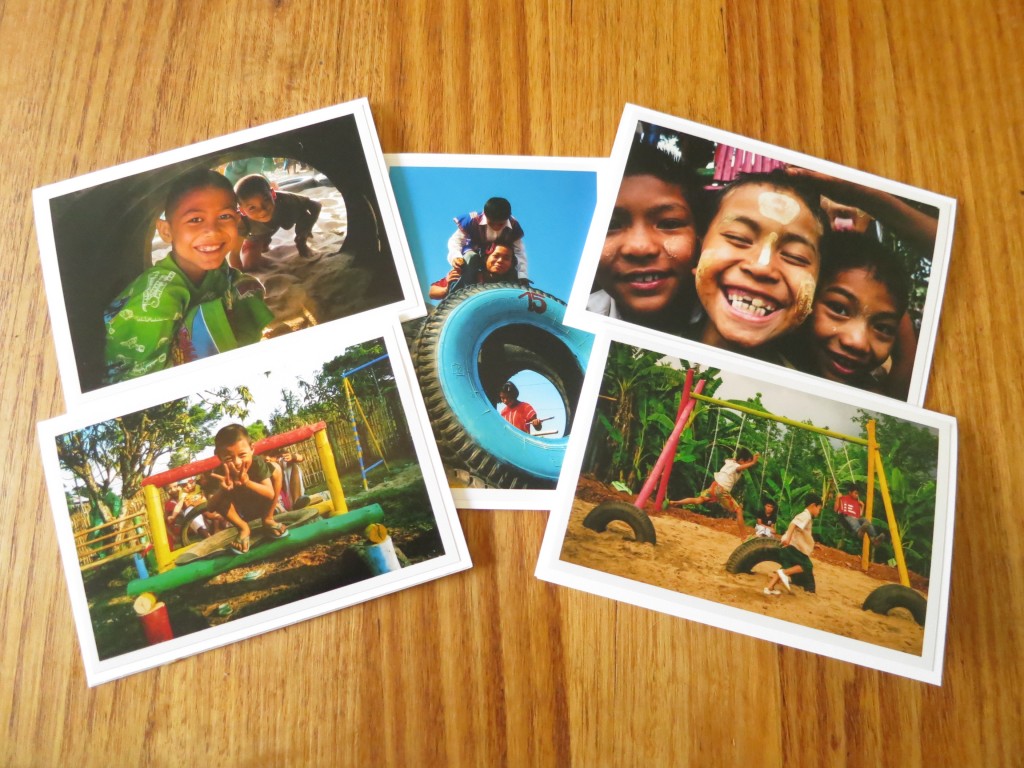
We have a limited amount of handmade Christmas cards for sale. Handmade by Aussie kids (Princes Hill Primary Schools) and communities (Solace) to build Playgrounds in The Phillipines. They are archive quality photos on premium KW Doggett paper. Eack pack with 5 different cards with envelopes is $20 bucks. Postage in Australia is an additional $3 and internationally an extra $7.

To see all the images in more detail. See HERE.

Note: If you wish to purchase more cards than the amounts below please email Marcus at 'Marcus @playgroundideas.org'

Have a great playful christmas!


Choose one option
Pick-up cards $20.00 AUD1 pack with Aus postage $23.00 AUD1 pack with Inter postage $27.00 AUD2 packs with Aus postage $43.00 AUD2 packs with Inter postage $47.00 AUD
Enter Name / Full Address


BEAUTIFUL Homemade Christmas Cards
26 Oct
WHY PLAY?
Posted by Marcus Veerman

Playing at Smith Memorial Playground and Playhouse. Photo: MetroKids Magazine

Saturday, September 23, 2011 was an exciting day in the city of Philadelphia. Mayor Michael Nutter issued a proclamation declaring it the official “Philadelphia Declaration of Play” day.
A group of individuals in support of the importance of play in children’s lives gathered at the Smith Memorial Playground and Playhouse to declare this support once and for all and to make a commitment to the children of Philadelphia that they will fight for their RIGHT to play. Among those in attendance were local educators, doctors, psychologists, and parents and everyone came together to sign the “Philadelphia Declaration of Play”.

So, why all the fuss? Why is play so important for children?

Allow me to explain through the thoughts of the speakers and attendants of the Philadelphia Declaration of Play event….

Despite what some tend to think, play is not a privilege to be controlled or taken away. Rather, it is right. It is a necessity. It is like air and water to children. It is absolutely integral to the emotional, social and neurological development of children. It is about learning to control your environment, learning to be a generous, compassionate, collaborative, creative, innovative, tenacious individual.

One speaker put forth her “6 C’s” that make a successful kid: Collaboration, Communication, Content, Critical Thinking, Creative Innovation, and Confidence. Where can all these things be learned? On the playground. It has been proven in various studies that kids in classrooms centered around learning through play score higher on tests. Play works. Because play is a child’s natural way of learning. You can only swallow so many facts at once, but PLAY is active. Play is learning by DOING. Play is a child discovering and learning for his or her self.

Play is important. Play is essential.

Attendants sign the Philadelphia Declaration of Play. Photo: Ken Yanoviak

Speakers holding the signed Philadelphia Declaration of Play. Photo: Ken Yanoviak

 
WHY PLAY?
4 Sep
Bush Kinders. if only every child had this opportunity
Posted by Marcus Veerman

children who play in the forest

A bush kinder or primary school is basically an educational place that is held in place that is completely or mostly natural setting.

Wikipedia describes it as:

"A forest kindergarten is a type of preschool education for children between the ages of three and six that is held almost exclusively outdoors. Whatever the weather, children are encouraged to play, explore and learn in a forest or natural environment. The adult supervision is meant to assist rather than lead. It is also known as Waldkindergarten (in German), outdoor nursery, nature kindergarten, or nature preschool."

Although as adults the idea of spending whole days outdoors "rain, hail or shine" may not be their idea of anything but exaustion, it seems that this is what children are born to do. At playgroundIDEAS we know that Play is the tool children use to create their fundamental understandings of the world


School's Out: Lessons from a Forest Kindergarten from Rona Richter on Vimeo.

Bush Kinders. if only every child had this opportunity
4 Sep
The Importance of Play by guest blogger- Evan Kidd
Posted by Guest Author

On the importance of play


by Dr Evan Kidd – The Australian National University

Play is a universal human activity. In all but the rarest of circumstances, children in every village, town, and city across the world engage in some form of play, whether it be pretending to be Batman in New York City or making dolls from natural materials in the highlands of Papua New Guinea. When a behaviour is common across cultures, it suggests that it might have an important function to our species. But to the casual observer play just seems to be something that kids do to pass the time. What benefits might play have?

It turns out that play is associated with many beneficial developmental outcomes, some of which are predictable and others not. For instance, most people would expect that physical play such as running and climbing leads to positive physical development, but not everyone realises that physical play is also crucial for brain development as well as being an excellent form of stress relief, leading to greater psychological health.

Play also appears to have social and cognitive benefits. Play is an excellent context in which children learn important social skills, such as peer interaction. When children have ‘play-dates’ they aren’t just having fun, they’re learning important socialising skills such as turn-taking in conversation, negotiation, and conflict resolution. No wonder play has been linked to important skills such as understanding other people’s thoughts and feelings, as well as children’s language development. Finally, play seems to be an important medium through which children can begin their long journey through formal education. Studies have shown that children who attend schools that have a play-based curriculum not only learn well, but enjoy ;learning too.

Play is a powerful activity, but because we mainly think of it as a childhood activity we often fail to realise how important it is. In fact, organisations in the Western world have become concerned about the decreasing lack of opportunities children have to play. The American Academy of Pediatrics links “increases in depression and anxiety to a lack of unstructured playtime”, and recommends that children spend at least 60 minutes each day in open-ended play. This tendency to devalue play is by no means a problem limited to Western industrialised countries: the UN is currently preparing a General Comment on Article 31 – the Convention on the Rights of the Child, in response to a 2010 report by the International Play Association, which reported pervasive cross-cultural misunderstandings of the importance of play. It seems that we are underestimating the importance of play to children’s development.

We need to start treating play more seriously (but not too seriously!), both in the lives of our own children and those in countries where children do not have the kinds of privileges available to us. We will all be better off for it.

Playground Phone

The Importance of Play by guest blogger- Evan Kidd